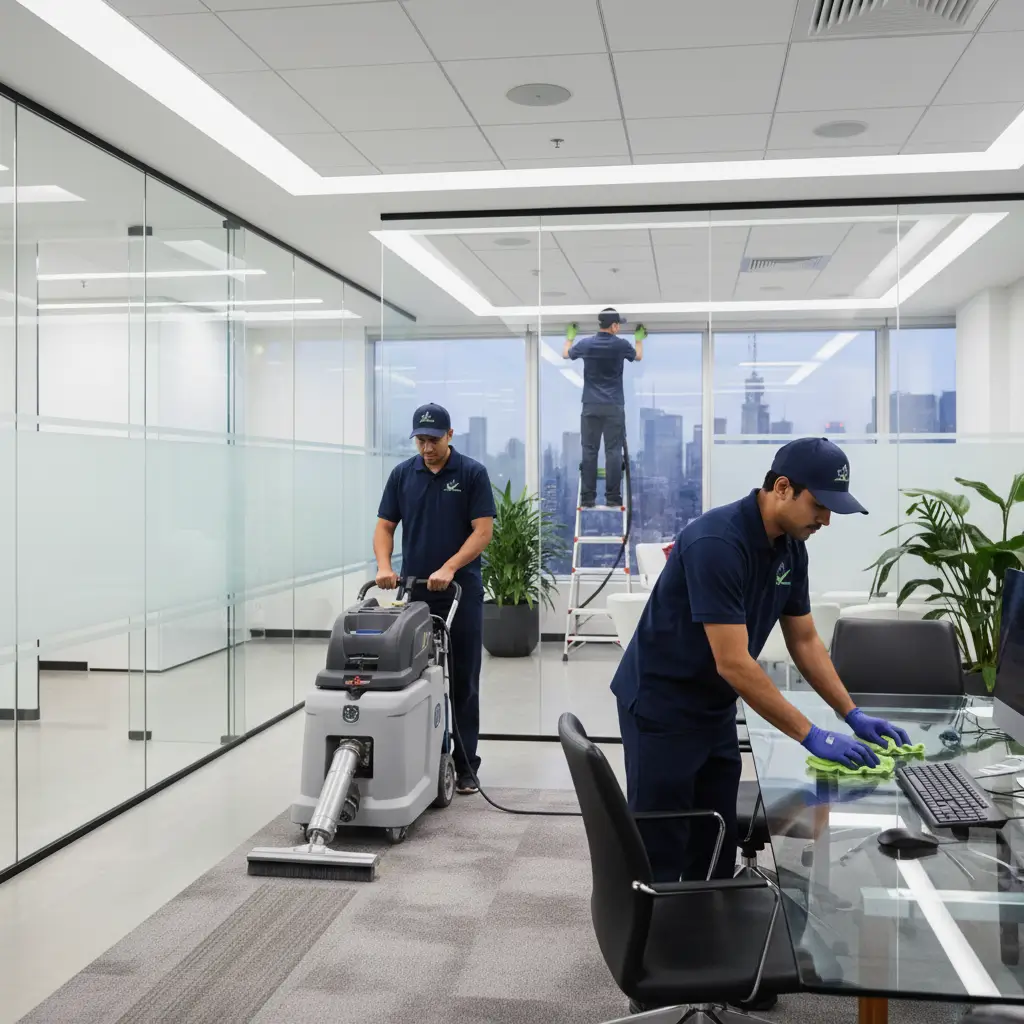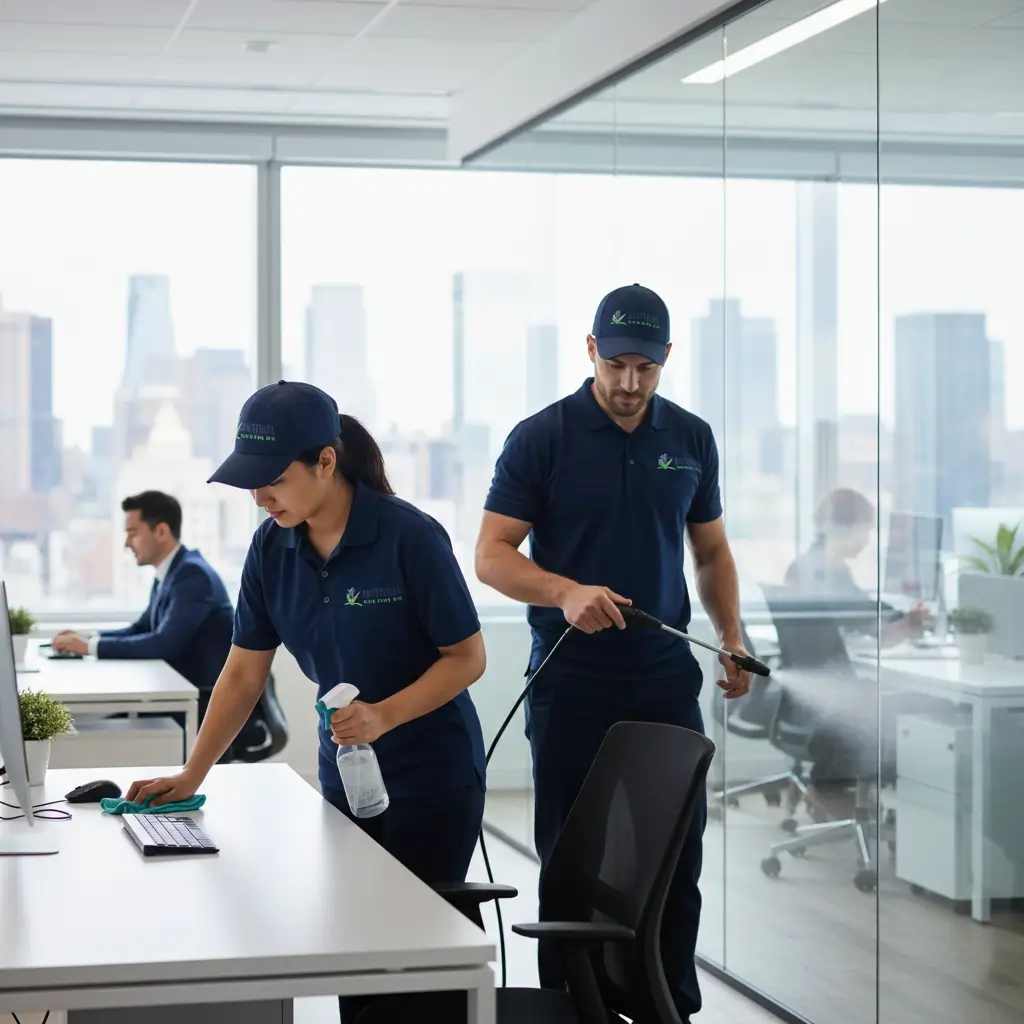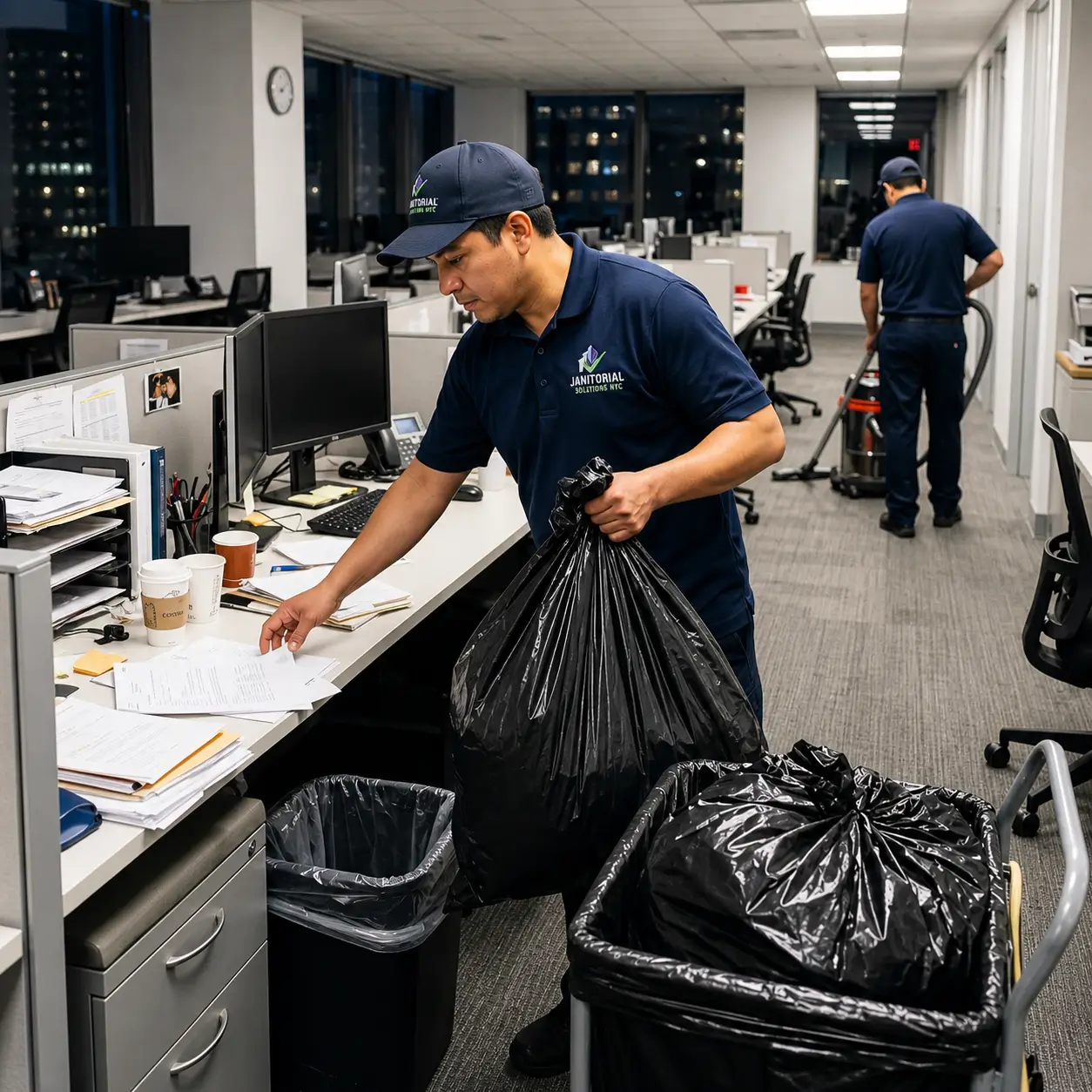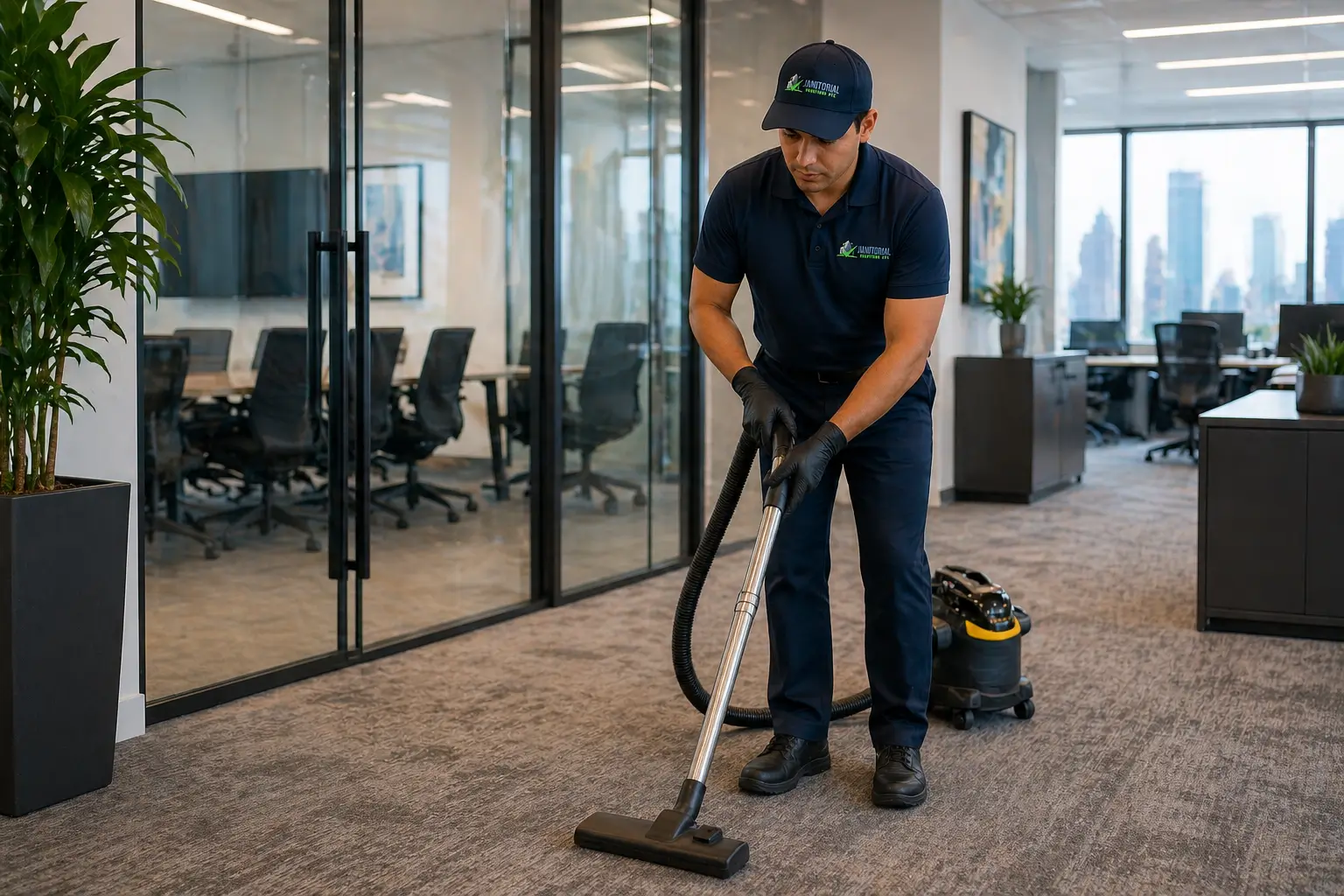
Commercial cleaning includes trash removal, restroom sanitation, floor care, dusting, disinfection of touchpoints, and upkeep of every shared area in your building. A full scope also carries periodic work like carpet extraction, window washing, upholstery care, and high dusting on a set cycle. What actually lands in your contract comes down to your building type, your foot traffic, and what you put in writing before the first visit.
Standard Cleaning Checklist for New York Businesses
Start with the baseline. Whatever your industry, a commercial cleaning plan in New York opens with the same foundation:
- Trash and recycling removal from every bin in the space
- Vacuuming carpet and sweeping or mopping hard floors
- Dusting horizontal surfaces, sills, and ledges within reach
- Disinfecting door handles, light switches, and shared equipment
- Restroom cleaning, disinfection, and restocking
- Pantry and breakroom counter, sink, and appliance exterior cleaning
- Glass door and partition spot cleaning
- Lobby and reception presentation
Everything past this list is a decision you make. Some of it costs almost nothing to add. Some of it costs a lot to skip.
A Walk Through Your Building, Room by Room
Scope makes more sense when you stop reading it as a list and start walking it as a route. Here is what a crew handles as they move through a Manhattan office floor.
Entrance and reception
Mats get vacuumed or pulled and cleaned underneath, because the soil hides below them. Glass doors get both sides done, along with the push plates and handles. The reception counter gets wiped and disinfected. The floor gets mopped or vacuumed out to about 20 feet, since that first stretch takes most of the dirt from the street.
Open floor and workstations
Trash and recycling pulled from every desk. Carpet vacuumed with attention to the traffic lanes rather than a straight pass. Desk surfaces were wiped where they are clear. Chair bases, drawer pulls, and shared monitors were touched. Cable trays and under-desk areas are dusted on a rotation instead of nightly.
Conference rooms
Table cleaned and disinfected. Chair arms were wiped, since that is where hands sit for an hour. Whiteboards cleaned. Remote controls, conference phones, and touch panels disinfected. Crumbs vacuumed from under the table after catered meetings.
Restrooms
Toilets, urinals, sinks, faucets, and partitions are cleaned and disinfected. Floors are mopped with a separate mop head from the rest of the building. Mirrors cleaned. Soap, paper towels, and toilet paper restocked. Bins emptied and liners replaced. Grout around fixture bases is treated on a cycle.
Pantry and breakroom
Counters and sink cleaned. Appliance exteriors were wiped, including the fridge door handle and microwave handle. Table and chairs cleaned. Floor mopped. Trash removed with liner replacement.
Elevators, stairwells, and corridors
Elevator floors vacuumed or mopped. Door tracks cleaned, since that is where grit collects. Call buttons and interior panels disinfected. Handrails wiped. Corridor carpet vacuumed and baseboards dusted on a rotation.
The Desk Problem Most Scopes Skip
Here is where a lot of NYC contracts quietly fail, and the reason is a research finding most business owners have never seen.
Dr. Charles Gerba of the University of Arizona sampled offices across New York, San Francisco, Chicago, and Tucson. His team found the average office desk carries around 5,015 germs per square inch, which works out to roughly 400 times more bacteria than the average toilet seat. The office phone tested even higher at about 5,585 per square inch. In reporting on the study, Gerba noted that bacteria levels climbed through the day and peaked after lunch when desks were not wiped with disinfectant.
Toilet seats came back among the cleanest surfaces tested. The reason is not a mystery. Restrooms get cleaned every day because everyone assumes they are germy. Desks and phones get skipped because they look fine.
So when you read a scope of work, check what it says about desks. Many contracts write “wipe clear desk surfaces” and stop there. That single line decides whether the germiest surface in your office gets touched or ignored. Phones, keyboards, and mice belong in the scope by name.
Also Read:
Restrooms Carry Requirements That Sit Outside Your Preference
Restroom work is the one part of the scope where federal law has an opinion.
The OSHA sanitation standard 29 CFR 1910.141 requires that toilet facilities and washing facilities be maintained in a sanitary condition. It also requires that waste receptacles be emptied at least once each working day unless unused, and kept in a clean condition. Floors have to be kept as dry as the work allows.
For a NYC business, this shifts restroom cleaning from a service choice to an obligation. A landlord or employer running restrooms on a twice-weekly schedule in a building with 200 staff is not saving money. That is exposure sitting on the books, and it becomes visible the moment a complaint reaches an inspector.
The Periodic Work That Belongs in the Scope but Runs on a Cycle
Nightly work handles what accumulates in a day. The rest of the scope handles what accumulates over months, and it runs on a calendar rather than a route.
- Carpet extraction: hot water extraction to pull embedded grit out of the fibers, usually every six to twelve months in an office.
- Floor stripping and refinishing: removing the worn finish and rebuilding it, one to four times a year, depending on traffic.
- High dusting: vents, ledges, sprinkler heads, light fixtures, and exposed ductwork, quarterly for most buildings.
- Window washing: interior glass quarterly, with exterior work scheduled by building height and access.
- Upholstery cleaning: chairs, sofas, and fabric partitions, once or twice a year.
- Grout and tile deep cleaning: restroom and entrance tile on an annual cycle.
These are the items owners cut first and regret later. Clear window cleaning in a storefront or a Midtown office changes how the space reads from the street, and it takes a fraction of what a facade cleaning costs once film has bonded to the glass. Fabric follows the same pattern. Regular upholstery cleaning keeps chair fabric from holding dust and odor, and it costs far less than replacing a conference room set.
What Falls Outside the Scope Unless You Ask for It
This is the part almost no cleaning company puts on its website, and it is where most disputes start. A standard commercial cleaning contract usually leaves these out:
- Interior of the refrigerator, microwave, and dishwasher
- Inside cabinets, drawers, and storage closets
- Blinds, curtains, and window treatments
- Light fixture interiors and bulb replacement
- Dishes left in the sink
- Exterior windows above the ground floor
- Sidewalk, entrance steps, and exterior areas
- Personal items and paperwork on desks
- Biohazard cleanup and bodily fluid response
- Plant watering and care
- Server room and equipment interiors
None of this is a company cutting corners. It sits outside the standard scope by convention, and any of it can be added once you name it. The mistake is assuming it is covered, then discovering in month four that nobody has opened the fridge since the contract started.
Ask for the exclusion list before you sign. A company that hands it over without hesitating is telling you something about how they operate.
How the Scope Changes by Business Type
The core stays the same. The additions change based on what happens inside your walls.
Medical offices and clinics add documented disinfection of exam rooms, treatment surfaces, and waiting areas, along with regulated waste handling. The records matter as much as the work because the practice has to show what was done and when.
Restaurants and food service add degreasing of kitchen floors, hood area cleaning, drain treatment, and dining room resets. Restaurant cleaning in NYC also carries a health inspection angle, so the back of house scope is often tighter than the dining room scope.
Retail stores add fitting room cleaning, display and shelf dusting, and entrance glass on a daily cycle rather than a weekly one, because the storefront is the sales pitch.
Co-working spaces add hot desk disinfection between users, phone booth cleaning, and a much heavier touchpoint rotation, since the same desk gets four different people in a week.
Why the Scope Document Matters More Than the Hourly Rate
Two proposals can carry the same price and deliver different buildings. The gap is in the paperwork.
A written scope of work names each area, each task, and each frequency. It states what is nightly, what is weekly, what is quarterly, and what is excluded. Without it, “cleaning the office” means whatever the crew has time for on a given night, and quality slides without anyone being able to point to a broken promise.
Look for three things in a proposal. First, a task list broken down by area rather than a paragraph of general language. Second, a stated inspection process, with a supervisor checking the work rather than the client discovering problems. Third, a named process for changing the scope, because your needs shift as headcount grows.
Does Any of This Apply to Apartment Buildings?
The scope carries over to residential property with different rooms on the route.
A condo or apartment building runs building cleaning services across lobbies, corridors, elevators, mailrooms, laundry rooms, stairwells, trash rooms, and package areas. The nightly work looks familiar: floors, glass, touchpoints, trash. The periodic work looks familiar too, with hallway carpet extraction and lobby floor refinishing on a cycle.
What changes are the hours and the audience? Residents move through at 7 in the morning and 11 at night, and they walk past the same lobby every single day of the year. Trash rooms and laundry rooms carry an odor risk that an office never faces. Move-outs drop debris into corridors on no schedule at all.
The individual apartments stay outside the scope. A building contract covers common areas, and unit turnovers get priced separately as their own project.
Your Contract Is Only as Good as What It Names
Most cleaning problems are not effort problems. They are scope problems. The fridge nobody opened, the desks nobody disinfected, the carpet nobody extracted for three years until the traffic lane turned grey—every one of those started as a line that was never written down. By the time you notice, you are looking at a replacement quote instead of a cleaning invoice, and the crew did nothing wrong.
At Janitorial Solutions NYC, we build the scope before we build the price. We put every area, every task, and every frequency in writing; we tell you what is excluded up front, and we run supervisor inspections with checklists so nothing quietly drops off the route. Our commercial cleaning teams cover offices, medical suites, restaurants, retail, co-working floors, and residential buildings across New York, with daytime and overnight schedules, our own professional equipment, and plant-based products that are safe for occupied spaces.